


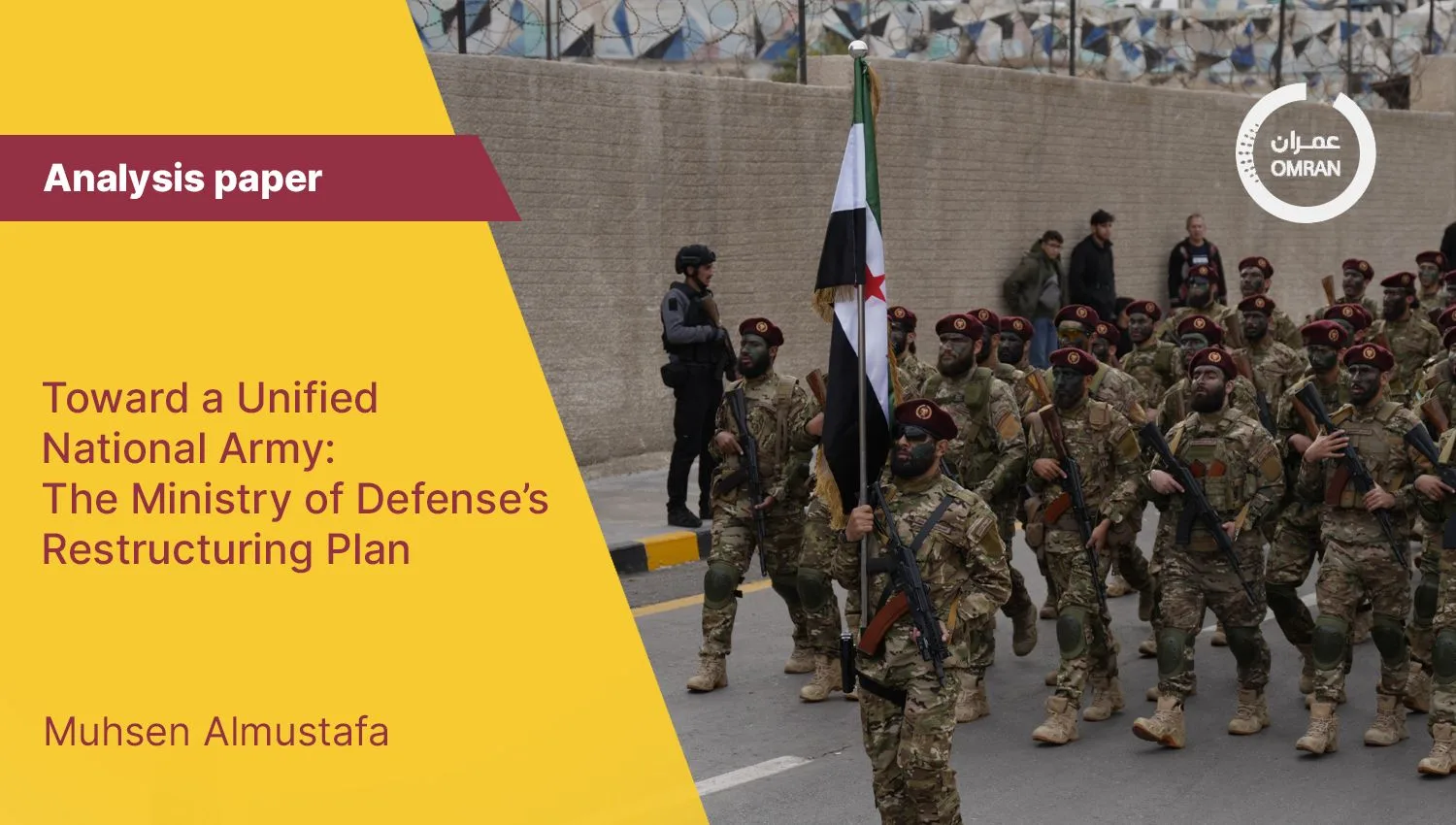
Toward a Unified National Army: The Ministry of Defense’s Restructuring Plan
The fall of the Assad regime reopened the question of the army as a state institution rather than an instrument of authoritarian rule, at a moment defined by a security vacuum and military fragmentation that compelled the state to rebuild centralized military decision-making and a legal monopoly over force
Executive Summary
- The fall of the Assad regime in December 2024 marked a foundational moment that reopened the question of the “army” as a state institution rather than an instrument of authoritarian rule. Against the backdrop of a security vacuum and a fragmented factional landscape shaped over years of conflict, the Ministry of Defense (MoD) emerged as a sovereign vehicle to unify military decision-making, monopolize the legitimate use of force, and rebuild hierarchy and discipline within a single command structure.
- The Defense Minister’s plan reflects a multi-level approach: operational measures to integrate factions, regulate ranks, and redistribute forces, alongside strategic tracks to rebuild military education, shape a national doctrine, and transition toward a “smaller, more professional army” based on voluntary enlistment rather than compulsory conscription as a tool of social control.
- The MoD has brought more than 130 factions under a unified structure and rejects any regional, religious, or ethnic particularism. However, unresolved integration—particularly the SDF file—remains the key stress test for unity of arms, chain-of-command coherence, and security sovereignty during the transition.
- The success of the defected-officers and rank-hierarchy track depends on carefully balancing the integration of experienced career officers with the professionalization of non-traditional field commanders through pathways that grant rank professional legitimacy, while keeping exceptions tightly limited. Ultimately, the real test lies in the Ministry’s ability to gradually reduce exceptions, unify appointment and promotion standards, and build a transparent evaluation system that prevents patronage and disguised quota-sharing from penetrating military decision-making.
- Operational experience in early 2026 points to a gradual shift from the “use of force” to the “management of force,” reflected in higher levels of discipline, phased execution approaches, safe corridors, and legal off-ramps for those who lay down their arms. Yet this progress remains fragile unless discipline is institutionalized as a durable policy through sustained accountability and oversight, clear rules of engagement, and tighter regulation of the internal information environment within units.
- Regionally, the Ministry of Defense is operating in an anxious environment that demands careful calibration: leveraging partnerships for training and knowledge exchange (Turkey, Saudi Arabia, negotiation tracks with Russia, and cooperation against ISIS) as capacity-building enablers—without becoming beholden to any single axis and without allowing external support to become a gateway for political interference in the army’s structure.
- The current phase represents a historic opportunity to establish a professional national army under civilian oversight, grounded in competence rather than loyalty. Ultimately, the plan’s success hinges on integrating transitional justice with military reform, adopting transparent standards for recruitment and promotion, and ensuring that the army remains subject to the constitution, the law, and effective oversight mechanisms.
Introduction
Following the fall of the Assad regime in December 2024, Syria entered a complex transitional phase marked by the disintegration of the former army’s traditional military and security structures. On the other side, the victorious camp was characterized by a proliferation of revolutionary and opposition factions with divergent ideological, political, and regional reference points. For years, this fragmentation constituted a strategic threat to the revolution and, later, to the durability of its military victory, particularly as repeated attempts to unify these factions or merge them into larger entities had failed on more than one occasion.
The new leadership moved swiftly to promote several officers who had held senior positions within the factions that participated in the “Deterrence of Aggression” operations room, appoint a Minister of Defense, and launch broad consultations with these factions including the Syrian National Army on restructuring the Ministry. This was an effort to centralize military decision-making and unify weapons under the authority of the state. The absence of a unified military institution was among the most significant challenges of this phase, prompting official efforts to reorganize the armed forces and build a national army capable of enforcing stability and contributing to the broader state-building project.
Later, after months of meetings and consultations, the first visible features of the new army began to emerge. This took the form of newly established military divisions bearing names distinct from those of the former army, as well as the appointment of revolutionary commanders to lead these divisions after being granted exceptional ranks. Officers were assigned to the formal staffing of these divisions, while additional officers some of them former defectors were promoted and appointed to leadership positions across various military units.
Against this backdrop, and as part of the broader restructuring effort, Defense Minister Major General Murhaf Abu Qasra outlined preliminary features of a plan to reorganize Syria’s military institution in an interview on 26 May 2025. The plan covered several key tracks, most notably: integrating armed factions into the Ministry’s structure; modernizing the military training system; reactivating defected officers and NCOs; developing a new national doctrine; strengthening weapons control; and reforming the ranks and promotions system([1]).
These steps do not merely reflect a technical attempt to reconstitute the army; at their core, they represent a political approach to rebuilding one of the country’s most consequential and historically contentious institutions an institution that has been at the heart of Syria’s military conflict since the outset of the uprising and at the center of political contestation since near-independence.
This paper analyzes the substance of the plan presented by the Ministry of Defense and situates it within Syria’s new post-conflict political and institutional context. It assesses the plan’s prospects for success and examines the structural obstacles that may hinder its implementation. In doing so, it unpacks the plan’s political and security implications and links them to broader questions of state-building and civilian governance of the military sector, given the central importance of this sector to Syria’s future and to the shape of its emerging military institution.
The Political and Military Context of Restructuring
The fall of the Syrian regime marked the end of an era in which power was concentrated in closed military and security institutions, governed by logics of sectarian as well as political and ideological loyalty more than competence and professionalism. With the dissolution of these apparatuses, the country faced a broad security vacuum, quickly filled by dozens of armed factions that had emerged over the years of the uprising. These factions varied widely in their organizational structures, ideological reference points, and willingness to place weapons under the authority of the new state. This plurality, while reflecting the breadth of participation in toppling the regime, also carried a persistent risk of fragmentation and disorder, and threatened the prospects of building a unified military institution.
The establishment of a new Ministry of Defense became one of the central pillars of building the new state not merely as an executive body, but as an instrument for asserting sovereignty and unifying military decision-making. From its inception, the Ministry faced a dual challenge: on the one hand, integrating factions with diverse ideological orientations that had fought the former regime, while ensuring they were not marginalized; and on the other hand, imposing institutional discipline capable of moving the emerging force from revolutionary fragmentation to professional military organization. This transition is highly sensitive, given local and regional balances and the urgent need to avoid triggering new fractures within the nascent military structure.
On 24 December 2024, Syria’s Military Operations Administration announced that it had reached an agreement to dissolve all armed factions in preparation for integrating them under the umbrella of the Ministry of Defense, following meetings between its then-leader, Ahmed al-Shara, and commanders of revolutionary armed factions([2]).
In preparation for this, the General Command appointed the engineer Murhaf Abu Qasra as Minister of Defense – after promoting him to the rank of major general- in the caretaker government([3]). It also appointed Ali Nour al-Din Na‘san as Chief of the General Staff, likewise after promoting him to the rank of major general([4]). Immediately following these appointments, the Ministry of Defense began holding organizational sessions with faction military leadership to initiate their integration into the Ministry. Hundreds of meetings have been held since
4 January 2025, including sessions with factions from the “Syrian National Army” previously affiliated with the interim government, factions from Suwayda, and the “Free Syria Army.” Most of these groups expressed readiness to join the new army under the umbrella of the newly established Ministry of Defense.
On 29 December 2024, Commander-in-Chief Ahmed al-Shara issued a decision promoting a group of officers to various ranks under the slogan of “building a strong and effective national army.” The decision sparked broad controversy, particularly because it included foreign, non-Syrian officers among those promoted. Some argued that the move was unlawful, or that the General Command had granted these foreigners Syrian citizenship([5]), drawing on an earlier statement by al-Shara in which he spoke of the possibility of granting citizenship to foreign fighters who had contributed to supporting the revolution([6]).
Subsequently, the Ministry of Defense requested detailed rosters listing the names of faction fighters and commanders and their specializations, as well as inventories of the equipment and military vehicles in their possession, to redistribute them appropriately within the restructuring process. The Ministry also rejected any proposal implying religious, geographic, or ethnic particularism for any armed faction. This stance came in response to a proposal by some factions in Daraa seeking recognition of a distinct regional status, and it was mirrored in the Ministry’s rejection of integrating the Syrian Democratic Forces (SDF) as a single bloc.
These positions were articulated amid negotiations that took place before a general agreement was reached between President Ahmed al-Shara and SDF commander Mazloum Abdi on
10 March 2025([7]), and prior to the early-2026 military operations that ended the SDF’s armed presence across large parts of the areas it had controlled for years([8]).
In a parallel track, efforts were undertaken to absorb many officers who had defected from the former regime’s army into the new structure, to leverage their expertise and place them in positions commensurate with their ranks, age, and operational circumstances. Priority in the initial phase was given to defected officers already serving within armed factions, followed by defectors residing outside the country. By contrast, military commanders with civilian backgrounds are to undergo training courses in military academies to qualify as commissioned officers. It is also worth noting that the Ministry of Defense is working toward building a professional, enlist-based army rather than relying on compulsory service, a matter that has yet to be definitively settled.
It became clear that the Ministry of Defense is not moving toward integrating armed factions as intact blocs within the army’s structure. Instead, personnel from these factions are to be redistributed gradually according to specialization and operational need across their new sectors of service, and the integration arrangements implemented thus far appear to be temporary and necessity-driven, aligned with the requirements of the transitional phase.
Despite the broad outlines presented in the announced plan, the mechanism for its implementation remains unclear, particularly given the range of challenges that continue to confront Syria’s new leadership. A central test is the continued presence of forces operating outside the chain of command, most notably the SDF as the military arm of the Autonomous Administration. In parallel, there are instances of local armed intransigence on the periphery such as the resistance of certain armed groups in Suwayda and the attendant risk of Israeli intervention, especially in the wake of the province’s events after 13 July 2025.
The Ministry of Defense’s efforts unfolded alongside growing international engagement in the Syrian file. Several influential states including Turkey, Saudi Arabia, Jordan, and even the United Kingdom in certain respects signaled a conditional willingness to support military and security restructuring initiatives, if transparency is ensured, violations are prevented, and the foundations are laid for the armed forces to be subject to civilian authority.
Nevertheless, the Syrian experience remains shaped by a heavy legacy of the militarization of politics and the politicization of the army, compounded by the diverse backgrounds of armed factions and the persistent challenges still on the ground. As a result, rebuilding the military institution remains contingent on a delicate balance between the imperatives of the transitional phase, the requirements of security stabilization, and the demands of long-term structural reform.
Core Features of the Ministry of Defense Plan
The plan presented by the Ministry of Defense represents the first official, public blueprint for reorganizing Syria’s military institution in the post-conflict period. It was introduced at a particularly sensitive moment, as the nascent state seeks to impose an institutional logic on a landscape that still bears the hallmarks of fragmentation and uncontrolled militarization. The plan’s content reflects a multi-level approach, combining immediate measures to integrate factions and regulate ranks and appointments with strategic steps to develop military education and reshape doctrine. What follows is an analysis of the plan’s main pillars, alongside an assessment of their practical implications and the surrounding challenges.
Unifying Command and Consolidating Weapons
The announcement of integrating more than 130-armed factions into the Ministry of Defense’s structure marked a highly significant step in the broader process of rebuilding and restructuring the defense establishment([9]). The new organizational framework for these factions was outlined, and their command and administrative subordination was transferred directly to the Ministry, with an explicit emphasis that integration is not voluntary but mandatory and that any faction refusing to merge would be treated as operating outside the state.
This direction reflects a concerted effort to end the era of “military decentralization” that became entrenched over years of war and to reassert state authority over military decision-making. However, the sheer scale of the factions and the diversity of their ideological and organizational backgrounds raise serious questions about the Ministry’s ability to ensure genuine discipline and coherence within a unified structure.
The consolidation of armed factions remains one of the most difficult obstacles to unifying military command both at the institutional level and at the level of individual behavior. Some cases of friction and non-compliance continue to surface periodically, which is unsurprising in the first year of a unification process and is likely to persist for some time until institutional norms take deeper root and cascade from the top down, ultimately becoming a direct obligation and an inherited organizational practice([10]).
Although the integration plan covered the vast majority of armed factions, the Minister noted that the SDF track is being managed separately, based on a “general agreement” between the two sides. This exception underscores the difficulty of achieving comprehensive unification, as the SDF remains outside the Ministry’s institutional framework. While temporary separation may be necessary for negotiation-related reasons, its prolonged continuation constrains the Ministry of Defense’s ability to assert full sovereignty and postpones a central sovereign imperative: the unity of command and arms.
With respect to weapons control, regulating arms is one of the core pillars of any state-building process particularly in post-conflict contexts where weapons are widely dispersed outside formal institutional authority. In this regard, the Minister of Defense revealed that a draft law is being developed in cooperation with the Ministry of Interior, aimed at monopolizing arms under state control and regulating possession.
While the very initiation of such legislation represents an important step, its effectiveness will ultimately depend on the enforcement capacity of the responsible bodies, the degree of compliance among integrated armed groups, and the availability of clear oversight and accountability mechanisms. These mechanisms must prevent the recycling of weapons through smuggling networks or semi-official structures, while also addressing the regulation of uncontrolled civilian firearms.
The effort to regulate weapons faces structural challenges that go beyond drafting legislation to the state’s actual ability to enforce it on the ground. Many armed factions still retain private arsenals, some dispersed across undeclared storage sites or held by field commanders with strong social, regional, or even sectarian influence. The widespread circulation of small arms among civilians coupled with the absence of an effective licensing regime—further complicates any attempt to legally monopolize weapons.
Added to this is the risk of parallel markets for buying and selling arms, which underscores the need for close coordination between the Ministries of Defense and Interior. Perhaps the most critical challenge lies in linking disarmament, on the one hand, to credible legal and societal guarantees for former fighters, on the other to prevent their drift into violence or into illicit wartime economies.
A further challenge, especially after the early-2026 battles, is closing the space for parallel structures in managing relations with forces that have not completed integration or that still retain their own chain of command, security apparatus, and independent administrative structures, most notably what remains of the SDF. In this context, an announcement of integration is not sufficient. What is required is a practical process that deals with hard operational details: conducting inventories of weapons and ammunition; registering and serializing individual firearms; securing and controlling storage depots; unifying military communications; establishing rules of engagement; setting coordination mechanisms at contact lines; and creating a joint operations center during the transitional phase to prevent “battlefield ambiguity” and incidents.
also, another challenge is operational sustainability in the face of evolving threats unfolding in parallel with the rebuilding of the army: residual armed networks, sabotage cells such as former-regime remnants or ISIS, and the possibility of local actors repositioning themselves to exploit gaps and weak control. Addressing this requires capabilities not slogans: building professional military intelligence, establishing an early-warning system, strengthening border security, developing agile light counterinsurgency units, and training for joint operations that integrate ground forces with intelligence and internal security.
At the same time, the Disarmament, Demobilization, and Reintegration (DDR) Program cannot be sidelined. Because it is a technical prerequisite for reducing the “surplus of arms” outside the institution and for shielding the army from attrition by non-state adversaries. Ensuring the institution’s durability also requires reforming supply and maintenance chains (spare parts, workshops, ammunition, fuel), standardizing procurement and contracting rules, building an organized reserve force, and linking discipline to a clear accountability chain. Only through these instruments can Syria prevent a return to factionalism in institutional guise and transform the nascent army into a measurable, improvable national force rather than a merely nominal umbrella.
The Defectors and Military Hierarchy
The file of defected Military personal is among the most sensitive issues in rebuilding the Syrian army, given the overlap it entails between legal, political, and symbolic dimensions. According to the Minister’s remarks, defected officers have been classified into two categories. The first includes approximately 2,200 officers who remained within faction ranks after defecting; more than half of them have been reactivated to date. The second category includes officers who defected but did not subsequently engage in military activity. Efforts to recruit and reactivate this group have begun, and around 2,000 officers have been reactivated so far out of 3,000 defectors who have been interviewed a process that remains ongoing([11]).
This approach reflects an effort to reclaim experienced military expertise and integrate it into the structure of the new army. However, it confronts challenges related to trust, accountability for past conduct, and the extent to which returning officers will accept a new hierarchy that may place them in positions below their previous standing. To manage the gap between defected career officers and commanders who emerged from revolutionary factions, the Ministry of Defense has adopted a dual-track promotion formula that seeks to balance legal criteria with field competence. For defected officers, files are reviewed by a specialized committee that relies on official service records, ranks, and specializations, while considering exceptional cases through a dedicated settlement program.
As for revolutionary commanders, they are required to enroll in the military academy and complete training to obtain the rank of second lieutenant. Their subsequent exceptional promotion is then assessed based on three criteria: performance at the academy, years of fighting and service, and the functional post that requires a specific rank. While this mechanism appears fair on paper, its implementation raises questions about who will control the evaluation criteria and whether the Ministry can prevent political pull and legacy networks from undermining the construction of a genuinely professional hierarchy.
Regarding defected enlist non-commissioned officers (NCOs) from the Assad-era forces, the Ministry announced in November 2025 that it had begun receiving return-to-service applications. A large number have since started reporting to recruitment branches in their governorates to be processed and assigned according to specialization. The Ministry aims to integrate the experience of defected NCOs with new recruits and transfer practical know-how to them. It is expected to receive around 4,000 applications from NCOs seeking to return([12]).
The issue of military hierarchy and ranks is among the most complex challenges in the context of restructuring the army, given the circumstances under which armed factions emerged and the diversity of their leadership—ranging from defected officers to revolutionary commanders with civilian backgrounds. Hayat Tahrir al-Sham (HTS) also granted ranks to officers after subjecting them to military courses at the academy it had previously established in Idlib.
The Ministry of Defense appears to recognize the sensitivity of this issue and has therefore linked the granting of ranks to two parallel tracks: regularizing legal status and issuing a regulatory law governing the process. Nevertheless, the Minister acknowledged the existence of “exceptional cases” being handled outside this framework, which risks reproducing earlier abuses and undermines the credibility of reform unless such exceptions are tightly controlled through transparent, time-bound mechanisms.
Organizing military ranks carries a symbolic weight that goes beyond administrative procedure. It signals how legitimacy is ordered within the new institution and sets the internal balance of power within the nascent army. Between a defected officer with extensive experience but a break from regular service, and a field commander who fought decisive battles without an academic background, there is a clear need for a hierarchical ladder that recognizes experience and contribution without undermining institutional logic.
In this context, the announced promotion committee becomes a real test of the Ministry’s ability to generate objective standards that are insulated from favoritism and factional quota-sharing an outcome that cannot be achieved without a clear legal framework and oversight mechanisms that verify the consistent and transparent application of criteria.
Despite the ambitious character of the Ministry of Defense’s plan, its implementation confronts a set of structural and political challenges. Foremost among them is internal cohesion within the new military structure. Members’ backgrounds vary widely from professional officers who defected early, to revolutionary faction commanders who accumulated battlefield influence, to newly enlisted personnel driven primarily by employment needs or security considerations. While this diversity reflects a broad spectrum of experiences, it also carries the seeds of competition over status and decision-making within the nascent army.
The promotion and appointment criteria could easily become arenas of quiet contestation unless they are managed through a clear, transparent system grounded in unified legislation that applies equally to all. If military leadership backed by political leadership fails to impose a professional hierarchy based on competence and loyalty to the institution, the unified army may gradually slide into internal bloc formation that reproduces factional logic under institutional cover.
Toward a Professional Army and a New Military Doctrine
From the earliest stages of establishing the Ministry of Defense, the drive to build a professional army appeared to mark a fundamental shift in Syria’s military philosophy after decades in which compulsory conscription functioned more as an instrument of social and political control than as a mechanism for building a professional force. The Minister announced an intended shift toward a model based on enlist army rather than conscripts, to be selected according to three criteria: physical fitness, a clean record free of serious crimes, and an age requirement.
This shift signals an orientation toward building a smaller, more disciplined force capable of performing its duties under a professional doctrine. Yet the success of this model remains contingent on the Ministry’s ability to provide adequate incentives for voluntary enlistment and to select recruits objectively away from the regional or political considerations that long shaped recruitment practices under the Assad regime, where sectarian loyalty, rather than competence, often determined selection.
In parallel with the shift toward professional army, the Ministry of Defense has placed particular emphasis on reactivating and upgrading the military education system by establishing ten new military academies and updating their curricula to align with what the Minister described as the “sciences of the modern age.” This modernization was presented as necessary given the deterioration of military academies under the former regime, which suffered from structural decay and relied on outdated, ideologically driven curricula.
Developing military academies goes beyond infrastructure; it requires building a professional training apparatus and attracting academic expertise capable of producing officers with comprehensive qualifications. Yet sustaining this track will require a long-term plan to safeguard the quality of military education and link it to career progression so it does not devolve into a merely procedural gateway for issuing ranks.
Subsequently, the Ministry of Defense announced that the military academies (Ground force, Air force, and Navy) would be included in the general admissions process for high-school graduates, subject to a set of conditions and general regulations([13]). The Ministry also participated through the leadership of the military academies in the “Your Academic Destination” forum held in several Syrian governorates under the supervision of the Ministry of Higher Education, aimed at helping students choose their future fields of study. In this context, the Ministry of Defense emphasized the role of the military institution in supporting young people’s educational and professional pathways([14]).
The Minister of Defense announced the Ministry’s intention to develop a new military doctrine centered on protecting Syria’s borders and the Syrian people an important departure from the former Assad army’s doctrine, which was built on partisan loyalty and an internal coercive function. The discussion of doctrine gains deeper significance when viewed against the transformation of the actors who formed the core of the victorious armed force, foremost among them Hayat Tahrir al-Sham (HTS). Since 2017, HTS has gradually shifted while preserving some of its foundational values from a model rooted in ideological legitimacy toward a more Syria-centered approach, reflected in higher organizational discipline, localized rhetoric, and governance and service-delivery tools that generated internal legitimacy. This suggests that “doctrine” is not fixed; it is a system that can be re-engineered when anchored in training and education, moral guidance, discipline, and accountability.
According to the Ministry’s plan, this orientation reflects an intent to redefine the army’s role as an inclusive national institution that transcends ideological and regional divides—an institution whose primary mission is to protect sovereignty and the constitution, rather than defend a particular ruling authority. Translating this concept into an operational doctrine, however, requires more than political declarations. It demands a comprehensive review of military education programs, the content and tone of moral guidance, and the mechanisms governing promotion and discipline, so as to ensure that officers’ and soldiers’ conduct align with the new values this doctrine is meant to embody.
Adopting a national doctrine necessarily entails redefining the army’s function in Syria’s new state. It is no longer acceptable for the military to serve as an instrument of political control or internal repression, as it did in the previous era. According to the Minister’s statement, one objective of the new doctrine is to contribute to “preserving civil peace,” which raises critical questions about the boundaries of military involvement in domestic affairs namely whether the armed forces will play a complementary role alongside internal security services, or whether they may drift back toward policing functions that are not, in principle, within their remit.
This question becomes even more consequential in a fragile social environment marked by multiple societal, ethnic, and sectarian divisions. It therefore requires heightened caution in calibrating the relationship between military doctrine and the army’s domestic role, so that “protecting civil peace” does not become a new rationale for excessive security intervention.
On this basis, an inclusive national doctrine for the Syrian army should be constructed as an overarching framework that integrates diverse experiences into a single standard: protecting sovereignty, the constitution, and the Syrian people within the bounds of law, while remaining neutral toward sectarian, ethnic, regional, and political divisions. This must be translated into clear operational instruments academy curricula, rules of engagement, a defined boundary between the army’s domestic role and that of internal security, and a moral guidance system that prevents the politicization of arms. Under this formulation, the doctrine becomes “national” because it unifies the meaning of force and its purpose within a single institution not because it ignores diversity of backgrounds, but because it disciplines that diversity through one legal and institutional standard.
Operational Performance and Field Discipline
One year after the establishment of the army, the battles it fought in Aleppo’s Sheikh Maqsoud and Ashrafieh neighborhoods and across the eastern countryside extending toward al-Jazira in early 2026 served as a practical test of the level of discipline and professionalism the Ministry of Defense has sought to instill. During these operations, the Ministry emphasized meticulous planning, cautious and phased execution, precision targeting, the opening of safe corridors, and the management of evacuations in coordination with state institutions. It also provided legal off-ramps for those who laid down their arms to reduce losses and pre-empt retaliation narratives, with the aim of neutralizing SDF fighters while maximizing civilian protection([15]).
These military operations provided a clear indicator of a gradual shift from the use of force to the management of force, accompanied by a notable rise in discipline and compliance with the Ministry of Defense’s directives, Code of Conduct, and professional conduct bulletins. This shift goes beyond the tactical dimension to reflect a structural evolution in civil–military relations, because success in populated environments is no longer measured solely by battlefield gains, but by the institution’s ability to consolidate security without producing a new social antagonism.
This is achieved by insulating society from the fighting and regulating the operational space before engagement such as by declaring closed military zones or designating specific points as military targets to be struck thereby constraining individual discretion and strengthening accountability.
Nevertheless, the model remains vulnerable to disruption by limited lapses that may be socially interpreted as institutional behavior rather than individual misconduct and politically exploited to revive fear-based narratives or invite external interventions. This makes swift and firm accountability a prerequisite for protecting gains a point underscored by the detention of violators by the security directorate and the military police. To entrench discipline as a sustainable state policy, the recommendations can be distilled into four interlinked pillars:
- Activating accountability as an internal deterrent tool through effective field inspections, disciplined documentation, graduated sanctions, and linking a commander’s responsibility to the conduct of his personnel.
- Establishing safe and rapid civilian complaint channels connected to the Military Police and local authorities.
- Deepening training on rules of engagement, civilian protection, and crowd management, while reinforcing the principle that controlling anger is part of strength.
- Regulating the information and media space within units, as digital disorder often precedes disorder on the ground.
The discipline demonstrated represents an opportunity to redefine the relationship between the army and society based on law rather than fear provided it is institutionalized as a durable culture that matches rhetoric with practice and treats violations as threats to national security, not merely individual mistakes. These military gains, achieved with discipline and professionalism, have strengthened state authority and consolidated confidence in the restructured Syrian army’s capacity to impose security and stability without reverting to the practices of the past([16]).
In doing so, the military institution in its new phase has demonstrated that it is beginning to genuinely evolve into a professional national army, one that is accountable, committed to protecting all components of the Syrian people within the framework of law, and a practical translation of the military doctrine previously articulated by Syria’s Minister of Defense.
Civil–Military Relations Within the Constitutional Framework of Restructuring
The Ministry of Defense’s plan to reorganize the military institution cannot be read merely as a technical process of integrating factions and redistributing forces. It is directly connected to reconstituting civil–military relations in post-2024 Syria([17]), and to a core question: how can a professional national army be built to protect the state and society without becoming a center of political power and how can a return to factionalism in institutional guise be prevented? In this regard, the constitutional declaration provides an initial reference framework for constraining armed force and anchoring its use in state logic and the rule of law. It does so by defining the army’s function, monopolizing weapons under state authority, and subjecting declarations of war and emergency to institutional constraints within a higher-level decision-making architecture.
This framework reflects an orientation toward “objective civilian control” through two core principles: the state’s monopoly over force, and the consolidation of the army’s function as a professional national institution serving clearly defined sovereign objectives (protecting the country and territorial unity) within a legal commitment that safeguards rights. Linking mobilization, war, and states of emergency to an institutional track routed through the National Security Council also creates, in theory, a platform for joint decision-making that balances security imperatives with the requirements of legitimacy.
Yet the effectiveness of this arrangement depends on preventing a slide toward personalized decision-making or the conversion of transitional exceptions into permanent norms namely, shifting “political trust” from a relationship between individuals into rules, procedures, and clear mandates that define authorities, regulate information flows, and prevent the emergence of parallel chains of command.
Within the civil–military relations literature, this challenge can be understood through two analytical lenses: the guardianship model and the agency model. The guardianship model assumes convergence of objectives between civilian and military actors and frames the relationship as an institutional partnership organized around a unifying national purpose, an approach that appears well-suited to a transitional phase seeking to end factionalism, consolidate the state’s monopoly over force, and build a national army.
The agency model, by contrast, starts from the premise of divergent preferences and information asymmetries, and therefore emphasizes oversight, compliance, and accountability to discipline military behavior. While useful for deterring deviation, it can also produce a heavy monitoring bureaucracy that slows decision-making and encourages informal workarounds if controls become overly granular or if oversight tools become politicized.
In the Syrian context, the most realistic formula appears to be a hybrid model, one that balances a clear purpose-based partnership (guardianship) with enforceable accountability mechanisms (agency), without turning the relationship into a permanent regime of suspicion. In practical terms, this means anchoring the center of gravity of civil–military relations in three interlinked pillars: a joint state-level decision platform that produces security and defense policy within constitutional and legal boundaries, and that ensures professionally documented military advice; a unified chain of command that prevents dual authority and parallel channels, linking power to responsibility and discipline; and a written doctrine that translates “national rhetoric” into operational standards governing training, education, moral guidance, rules of engagement, and the boundary between the army’s domestic role and the role of internal security forces.
This framing helps clarify the core logic of the Ministry of Defense plan: integrating factions and unifying ranks are not ends in themselves, but entry points for securing a single chain of command and preventing the reemergence of internal blocs. Likewise, building a national doctrine is not a symbolic declaration; it is a mechanism to prevent competing reference points within the institution by defining the function of force and its limits.
Linking military legitimacy to performance, discipline, competence, and readiness rather than loyalty or influence, is also a prerequisite for building durable social trust, especially in a post-conflict environment where even limited lapses can be read as institutional behavior and politically instrumentalized. In this sense, the military reorganization plan becomes part of state-building itself: monopolizing force within the rule of law, managing civil–military relations through institutionalization rather than contingency, and integrating with Security Sector Reform (SSR) and Disarmament, Demobilization, and Reintegration (DDR) tracks to reduce surplus weapons and close the space for a return to factionalism or the remilitarization of politics.
Restructuring Amid Regional Uncertainty
Since its establishment, the Ministry of Defense has been undergoing a fundamental redefinition that goes beyond changes in names and leadership. It reaches into the core of military doctrine and international partnerships, aiming to rebuild the institution around clearly defined national interests. The current trajectory indicates a strategic shift toward constructing a national, non-politicized military institution whose priorities center on maintaining internal security, counterterrorism, and rebuilding relations with regional and international actors previously positioned in the opposing camp, except for Iran at present.
Relations with Turkey witnessed a natural pivot, culminating in a military cooperation agreement that became a cornerstone of the Ministry’s new orientation. This cooperation was not limited to border coordination on counterterrorism; it extended to advanced training programs and institutional knowledge exchange aimed at supporting security sector reform (SSR) and broader army restructuring efforts([18]). Through this agreement, the Ministry sought to draw on Turkey’s experience in building a professional army and integrating diverse armed factions under a unified institutional umbrella, particularly given Turkey’s longstanding ties with many of these factions.
Notably, the Syrian state has demonstrated an ability to manage the legacy of Russia’s military role. The relationship appears to be shifting from the dependency that characterized the Assad era toward a more complex phase of renegotiation rather than outright termination. Russia was, for decades, the Syrian army’s principal traditional ally, and despite Moscow’s earlier antagonism toward the Syrian revolution, a logic of mutual interests now appears to be shaping the relationship. Dozens of meetings and several official visits have reportedly taken place, exploring ways to strengthen defense ties and expand knowledge exchange and joint training across multiple fields. Both sides have emphasized cooperation in developing military training curricula and rehabilitating military cadres in ways that align with shared interests while preserving Russia’s strategic role in Syria([19]).
The Ministry of Defense also recognizes that Russia’s military presence, particularly at Hmeimim and Tartus, remains a reality that requires careful diplomatic and military management within a broader security framework. Available information suggests that ongoing negotiations and visits are not limited to redefining military cooperation; they also extend to determining the future of Russia’s presence in Syria and, by extension, the trajectory of bilateral relations([20]).
Cooperation with the United States appears to be entering a new phase a qualitative shift from being framed through the lens of terrorism listings to being treated as a partner in counterterrorism. Syria’s engagement with the Global Coalition to Defeat ISIS represents the most consequential geopolitical turn in this regard. Initially based on intelligence sharing and later formalized through a decision to officially join the coalition, this cooperation forms part of the government’s broader strategy to present itself as a credible partner in the global fight against terrorism.
Israeli intervention constitutes a structural constraint on rebuilding the Syrian army, particularly as it has targeted remaining heavy military capabilities and imposed a new operational reality in the south through incursions and the occupation of strategic positions atop Mount Hermon, accompanied by signals of intent not to withdraw. This is not only a sovereignty challenge; it is also an operational constraint on redeploying the army in the area, including the imposition of a heavy-weapons-free zone and potential restrictions on the type of armament permitted south of Damascus. There are indications that such constraints could later expand through pressure on arms import channels.
As a result, the Ministry of Defense faces a dual dilemma: maintaining a sovereign presence under a unified chain of command without triggering external constraints, while simultaneously building alternative capabilities less vulnerable to interdiction such as highly mobile light forces, reconnaissance and early-warning systems, flexible command-and-control communications, and low-signature armament. The objective is to prevent the south from becoming either a security vacuum or a de facto state-excluded zone.
Overall, the Ministry of Defense’s emerging pattern of international engagement reflects an objective deeper than the acquisition of weapons or training. The aim is to use partnerships with Turkey, the United States, Russia, and Arab states as leverage to reposition the Ministry within the landscape of international military cooperation, while reinforcing domestic civil–military relations that support its transition toward a national army: a defense institution tasked with protecting the state and its citizens, subject to accountability. This, in turn, constitutes a foundational condition for Syria’s future stability.
Conclusion
Six interlinked challenges directly shape the process of rebuilding and restructuring Syria’s military institution. First are internal challenges related to unifying military command, consolidating weapons, dismantling parallel structures, and preventing the emergence of zones of influence outside the national hierarchy. Second is managing the file of defectors and restructuring military hierarchy in a manner that safeguards rights, limits competition, and neutralizes informal networks. Third is building a professional army anchored in a new, inclusive national doctrine within a clearly defined constitutional framework. Fourth is sustaining operational performance and field discipline while avoiding the reproduction of past institutional distortions. Fifth is consolidating balanced civil–military relations and transforming existing trust into a durable institutional norm. Sixth is pursuing restructuring within an anxious regional environment shaped by both direct regional rivalries and broader global power dynamics.
Despite these structural constraints, the current transitional moment presents rare opportunities. For the first time in decades, there is a realistic prospect of establishing a military institution free from domination by a political party or a security apparatus. This creates space to anchor military doctrine in loyalty to the state rather than to a ruling system. Moreover, the battlefield experience accumulated by revolutionary factions can be institutionalized within a unified framework if integration and training are managed professionally. Properly harnessed, this experience could form the nucleus of a cohesive force combining operational proficiency with a clearly defined national orientation.
Unifying armed forces under the umbrella of the Ministry of Defense represents a strategic opportunity to end the plurality of military decision-making that has fueled post-conflict instability. Centralized command can restore the state’s legitimate monopoly over force and limit the instrumentalization of weapons for political bargaining. If accompanied by disciplined and professional conduct, such unification could also gradually rebuild societal trust and signal a definitive break from the ideological and security-driven model of the former regime’s army.
Civilian oversight is equally critical to entrenching the institution’s national character and affirming the principle of subordination to elected authority. Establishing mechanisms for parliamentary accountability, clarifying the limits of military involvement in public life, and enabling structured societal oversight can serve as safeguards against renewed politicization. Transparent standards governing promotions, funding, and deployments would further insulate the institution from factional contestation and reinforce confidence in it as a genuinely national body representing Syria’s diversity.
Ultimately, the plan to reorganize Syria’s military institution is not merely a technical reform effort; it is fundamentally political. Its success will depend not only on integration, training, and restructuring, but on alignment with a broader project of state-building grounded in the rule of law. Military reform cannot be isolated from transitional justice, security governance reform, and the redistribution of authority within the emerging state. Only through such integration can the armed forces become an anchor of stability rather than a renewed source of insecurity.
Accordingly, the reorganization plan must be anchored in a clear constitutional and legal framework defining the army’s mission, scope, and limits under civilian oversight. Recruitment and promotion standards must be unified and transparent to guarantee equal opportunity and prevent the reemergence of informal quota-sharing practices. Coordination between the Ministries of Defense and Interior should also be strengthened to ensure disciplined and comprehensive disarmament. Finally, military doctrine should be conceived not merely as operational guidance but as a vehicle for rebuilding national belonging, institutionalizing a new security culture that places the Syrian citizen at the center of the armed forces’ mandate.
([1]) “Interview with Syrian Defense Minister Murhaf Abu Qasra”, Syrian News Channel, 26/05/2025, https://bit.ly/4p9oZju
([2])“Al-Shara Agrees with Syrian Faction Leaders on Integration into the Ministry of Defense”, Al Jazeera Net، 24/12/2024, https://bit.ly/4ou5ZMB
([3])“Murhaf Abu Qasra… Syria’s Defense Minister After Assad’s Ouster”, Al Jazeera Net, 31/12/2024, https://bit.ly/4oCUsL3
([4])“Ali Nour al-Din al-Na‘san Appointed Chief of Syria’s New General Staff”, Al Jazeera Net, 11/01/2025, https://bit.ly/47ELCXe
([5])Omar Zakzouk, “Officer Promotions Spark Debate Among Syrians,” Al Jazeera Net, 30/12/2024, https://bit.ly/49gDFIY
([6]) Janblat Shkaye, “Syrian Street: Between Welcoming Naturalization of Those Who Fought Alongside the Revolutionaries and Concerns Over Civil Peace and Coexistence,” Al-Quds al-Arabi, 04/06/2025, https://bit.ly/3OsJFpk
([7]) “Text of the Agreement Between the Syrian State and the Syrian Democratic Forces (SDF)”, Al Jazeera Net, 10/03/2025, https://bit.ly/43sMb3H
([8]) “The Military Operation East of the Euphrates: A Reading of the Military, Local, and Media Roles”, Misdad: The Syrian Center for Security and Defense Studies, 01/02/2026. https://bit.ly/4adQ8vO
([9]) “Interview with Syrian Defense Minister Murhaf Abu Qasra”, Ibid.
([10]) “Syrian Defense Moves to Hold Violators of Professional Conduct Controls Accountable in Northeastern Syria”, Asharq Al-Awsat, 22/01/2026, https://bit.ly/3M7lzQs
([11])“Reintegrating Defected Officers”, Syrian Ministry of Defense, 04/11/2025, https://bit.ly/3LzB0jA
([12]) “Defense Sets Date for Receiving Applications from Defected NCOs”, Enab Baladi, 07/11/2025, https://bit.ly/4qSfxCL
([13])“Conditions for Admission to Military Academies”, Syrian Ministry of Defense, 07/09/2025, https://bit.ly/3WTG6cX
([14])“The Ministry of Defense Participates in the ‘Your Academic Destination’ Forum”, Syrian Ministry of Defense, 14/09/2025, https://bit.ly/3LX33cP
([15]) Muhsen ALMustafa, “Syrian Army Discipline: Standards and Sustainability Measures” Omran Center for Strategic Studies, 29/01/2026, https://bit.ly/4cRL17e
([16]) “Syrian Army Discipline: Standards and Sustainability Measures”, Ibid.
([17]) Muhsen ALMustafa, “Civil–Military Relations in Syria Face a Difficult Path Toward Institutional Balance”, Misdad: The Syrian Center for Security and Defense Studies, 08/09/2025, https://bit.ly/4mUQ3Cf
([18])“Syria and Turkey Sign a Military Cooperation Agreement”, SANA, 12/08/2025, https://bit.ly/4nV6tua
([19])“Defense Minister Concludes an Official Visit to Russia”, Syrian News Channel, 31/10/2025, https://bit.ly/4p9m1LV
([20]) Sasha al-Alou, Saba Abdullatif, “Between a Heavy Legacy and Geopolitical Shifts: The Syrian–Russian Turn Drivers, Opportunities, and Obstacles”, Omran Center for Strategic Studies, 07/10/2025, https://bit.ly/3WTPygr