
Research contributions, statements, and references

  • Icon from Carbon by IBM - undefined

    German

    Anders präsentiert sich die Lage im Libanon. Das Land hat eine knapp 375 Kilometer lange Grenze mit Syrien. Auch dieses Gebiet steht unter der Kontrolle von Baschar al-Assad. "Nachdem sie sich mit dem Assad-Regime auf die Namen der Rückkehrer geeinigt haben, finanzieren die libanesischen Sicherheitsbehörden nun die Rückführungen der syrischen Flüchtlinge an die Grenze", sagt Muhsen AlMustafa vom Omran Center for Strategic Studies in Istanbul im DW-Gespräch.

    English

    The situation in Lebanon is different as the country shares almost 375 km (235 miles) of border with Syrian areas under the control of Assad.

    "The Lebanese General Security funds return trips to the border after they agreed on the returnees' names with the Assad regime," Muhsen AlMustafa, who researches security and military in Syria at the Istanbul-based think tank Omran Center for Strategic Studies, told DW.

    Published in:
    Image2024-06-08
  • Icon from Carbon by IBM - undefined

    Muhsen AlMustafa, a researcher assistant specializing in civil-military relations at the Omran Center for Strategic Studies, told Enab Baladi that it cannot yet be confirmed that the regime has gained from the Gaza war, although there may have been material benefits from the UAE in return for not escalating against Israel.

    According to AlMustafa, Assad’s neutrality helped him ensure that his forces avoided further material and human losses on the military front, in case Israel launched attacks on military targets in Syria.

    Published in:
    Image2024-04-22
  • Icon from Carbon by IBM - undefined

    Regarding the mission assigned to “al-Nimr,” researcher assistant specializing in military affairs at the Omran Center for Strategic Studies, Muhsen AlMustafa, considered that al-Hassan “is an officer with the necessary capabilities to rebuild the Special Forces, due to his previous experience in counter-terrorism when he was in Air Force Intelligence and later his experience in transforming the Tiger militia into Division 25.

    He is supposed to be the right person to rebuild the Special Forces regiments again, especially since they suffered heavy losses during military operations and were severely depleted.” AlMustafa noted that Division 25 continues to conduct parachute jumps, which is a fundamental training activity for the Special Forces due to the nature of their work.

    Published in:
    Image2024-04-14
  • Icon from Carbon by IBM - undefined

    Muhsen AlMustafa believes that the nature of the proposed security changes in Syria is still unclear, as it has not yet been decided who will lead the new security apparatus if the Military Intelligence and Air Force Intelligence are merged. He points out that the regime will try to streamline the overlapping branches of the two agencies while keeping the non-overlapping ones, but he recalls that previous restructuring attempts failed due to the complexity and deep interconnections within the security apparatus.

    He stresses that Russia has greater influence than Iran over the Syrian security services, making it a likely party behind such changes, especially given the existence of four agencies with overlapping, competing roles. In his view, any restructuring could carry a political dimension within the framework of international understandings and fall under Moscow’s attempts to reshape the security system to serve its interests.

    He also argues that these changes may aim to obscure the crimes and violations committed by the security branches, but they will not succeed in deceiving international human rights bodies. Instead, they may make accountability more complicated, as international organizations would need to determine which new branch inherits the record of violations, thereby prolonging the accountability process without changing the essence of the existing security structure.

    Published in:
    Image2025-03-24
  • Icon from Carbon by IBM - undefined

    Muhsen AlMustafa, a researcher assistant specializing in security and military affairs at the Omran Center for Strategic Studies, described the changes as “natural within the framework of the regime’s restructuring plan, noting that the pace of changes in security positions is slower than in military ones.” Regarding his appointment to head National Security, AlMustafa explained that a set of qualities qualifies him for the position, most importantly “his closeness to Bashar al-Assad, and previously to Bassel al-Assad, which rooted his loyalty to the regime, despite his lack of extensive experience in foreign affairs compared to Mamlouk.”

    On the assumption that removing old faces and appointing new ones is aimed at improving the regime’s image in the security front, AlMustafa commented: “Getting rid of the old faces does not necessarily mean opening a new page, as the current officers are also subject to Western sanctions due to violations against the Syrian people that they committed in recent years.”

    Published in:
    Image2024-02-04
  • Icon from Carbon by IBM - undefined

    uhsen AlMustafa, a researcher assistant at the Omran Center for Strategic Studies, believes that the security restructuring announced by the Syrian regime has nothing to do with Arab initiatives, explaining that Damascus does not allow any external party to interfere in its security structures. He considers these changes to be a natural outcome for any regime that has gone through conflict, as it later seeks to review the strengths and weaknesses that emerged over the years.

    AlMustafa points out that the regime may exploit Arab and Western calls for reform to craft a suitable image for itself, enabling it to tighten its grip on the street, but without touching the essence of its security structure or management style. He stresses that Assad’s changes remain superficial, as the new security figures are no different from the old ones in terms of methodology and performance. He also notes that strengthening the position of the “Baath Party” at this stage is part of the regime’s plan, as it relies on it as a political tool that provides cover and a partisan facade concealing its sectarian nature. In this way, the party is used as a means of mobilization and control, instead of implementing genuine political reform or opening the door to structural changes in power.

    Published in:
    Image2024-01-31
  • Icon from Carbon by IBM - undefined

    Muhsen AlMustafa, a researcher assistant at the Omran Center for Strategic Studies specializing in military and security affairs, believes that building a professional army in Syria is far-fetched, as the army relies on loyalty in appointments and promotions rather than competence and professionalism, despite having an organizational structure of an Eastern style. He considers that human resources are the main obstacle to any transition toward a professional army.

    “Any army can be professional, but we must ask how and why professionalism is needed. The regime’s army has the structure of a professional army and adopts the Eastern model in the division of its units. However, the core issue lies in its human element, which makes it difficult to move toward a professional army.”

    Muhsen AlMustafa, researcher assistant at the Omran Center for Strategic Studies

    He stresses that the chain of command in the Syrian army has been heavily influenced since 2011 by Russian and Iranian interventions, both through official channels and informal networks of influence, which weakened decision-making centralization and made it harder to control certain units. Although Bashar al-Assad officially remains in control of the chain of command, in practice this control is subject to balances imposed by allies.

    AlMustafa points out that Iran is not interested in restructuring the army but focuses instead on bringing in militias and signing agreements that allow it to deploy and supply militarily, aiming to keep the regime weak but not collapsing. Russia, on the other hand, began steps toward restructuring but faced resistance from the regime itself, and its efforts slowed due to the war in Ukraine. Economically, he explains that the ongoing “restructuring” measures are administrative and low-cost, with the possibility of limited external funding to keep the army running, while heavy arms deals remain beyond the regime’s capacity.

    Published in:
    Image2023-12-25
  • Icon from Carbon by IBM - undefined

    Muhsen AlMustafa, a researcher assistant at the Omran Center for Strategic Studies, believes that Assad’s recent military decisions primarily aim to withdraw local militia members and integrate them into the army, since dismantling these groups all at once would be difficult in case they are needed in the future. In addition, the regime seeks to recruit new human resources from young men aged 18 to 32. He stressed that the regime is trying to attract them with financial incentives and exemptions from compulsory service, in order to secure their loyalty and push them to renew their contracts later, making the army’s ability to continue fighting dependent on the cohesion of these volunteers and militias.

    AlMustafa added that financing these plans relies on two main mechanisms: printing unbacked currency and imposing service substitution fees inside and outside Syria, which has provided the regime with resources to pay salaries despite the economic crisis. He also noted that the restructuring of the army aims to reduce any loyalty to Russia or Iran and concentrate it solely in Bashar al-Assad. He considers that the current Minister of Defense, Ali Mahmoud Abbas, is the officer tasked with implementing this plan, being a technical figure previously prepared for this role.

    Published in:
    Image2023-12-07
  • Icon from Carbon by IBM - undefined

    Researcher Muhsen AlMustafa at the Omran Center for Strategic Studies stated that “the privileges announced by the regime are not new; what is new is revealing them so explicitly.” He explained that the Syrian regime needs human resources in a routine sense, like any institution wishing to assert its presence amid the shortage of manpower in Syria, and that this is not necessarily related to military operations.

    AlMustafa suggested that the regime’s goal through these contracts is to withdraw members from militias and integrate them into the official military institution. According to him, those who sign these contracts are subject to the same laws that govern military service under Legislative Decree No. 18 and Military Pensions Decree No. 17 of 2003, covering compensations and other entitlements in cases of death or permanent disability.

    He clarified that compulsory service is waived for volunteers after five years of service under the law, considering that “these contracts are a continuation of the drive toward the militarization of society and military profiteering.” He added that through the salaries citizens receive under such contracts—which they cannot earn even in civilian jobs despite higher education degrees—it is clear that the regime seeks to militarize society, either by directing people into militias or using them as soldiers in the army.
    AlMustafa further explained that the regime exploits citizens’ needs through these contracts, offering financial incentives and encouragements to finish service within a defined timeframe, unlike in previous years.

    Published in:
    Image2023-11-29
  • Icon from Carbon by IBM - undefined
    ReferenceResearch Contribution

    Researcher assistant Muhsen AlMustafa at the Omran Center for Studies provided the European Union Agency for Asylum (EUAA) with answers to several questions related to military service and the situation in Syria. These contributions were included in the agency’s report titled “Syria: Country Focus 2023,” with the research input first sent by email, followed by an online interview with the agency. The report also drew on several previously published studies.

    The researcher assistant was recognized as one of the main sources in the report.
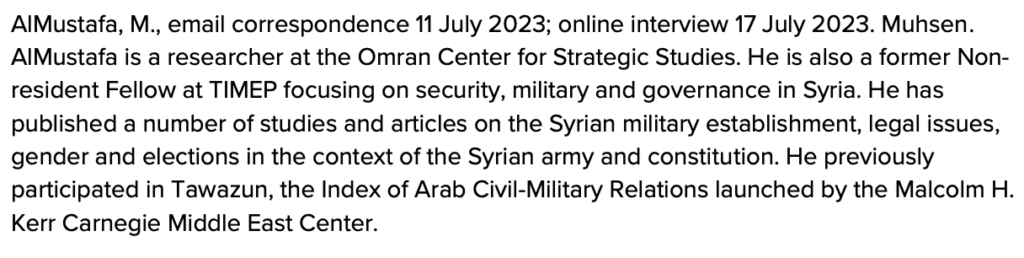
    The report also made use of several previously published Articles

    Published in:
    Image2023-10-02
  • Icon from Carbon by IBM - undefined

    Muhsen AlMustafa, a researcher assistant at the Omran Center for Strategic Studies, believes that Asma al-Assad is not the actual leader of the regime, but rather plays a role assigned to her by Bashar al-Assad in coordination with Maher al-Assad. He stresses that her task is to transfer money and build a new economic elite personally loyal to Bashar, Maher, and Hafez Jr., as part of a long-term project aimed at reshaping the regime’s power networks after the old ones, such as Rami Makhlouf, became exposed and vulnerable to Western sanctions.

    AlMustafa adds that the economic council linked to Asma emerged due to the large number of files she manages and relies on assistants and multiple companies to evade sanctions. However, he clarifies that her influence is concentrated only in the economic sphere. The army and security remain almost entirely under the control of the Alawite elite, while positions such as the Ministry of Defense lack real influence, which confines Asma’s role to the economy, away from sovereign and military files.

    Published in:
    Image2023-08-08
  • Icon from Carbon by IBM - undefined

    Researcher Muhsen AlMustafa at the Omran Center for Strategic Studies told Enab Baladi that this step is partly driven by an attempt to ease the burden on social groups in regime-controlled areas, while ruling out at the same time that it carries messages to Arab countries, considering that the issue is closely tied to the level of manpower in the “army” forces.

    According to the researcher, the issued order of demobilization and ending retention does not reflect full military stability as much as it expresses a state of “sufficiency” with the enlistment of new recruits. AlMustafa ruled out that large numbers of soldiers would benefit from the decision, since it is tied to conditions that do not apply to everyone, stressing that decisions related to the regime’s military institution are, nonetheless, real and consequential.

    Published in:
    Image2023-07-24