


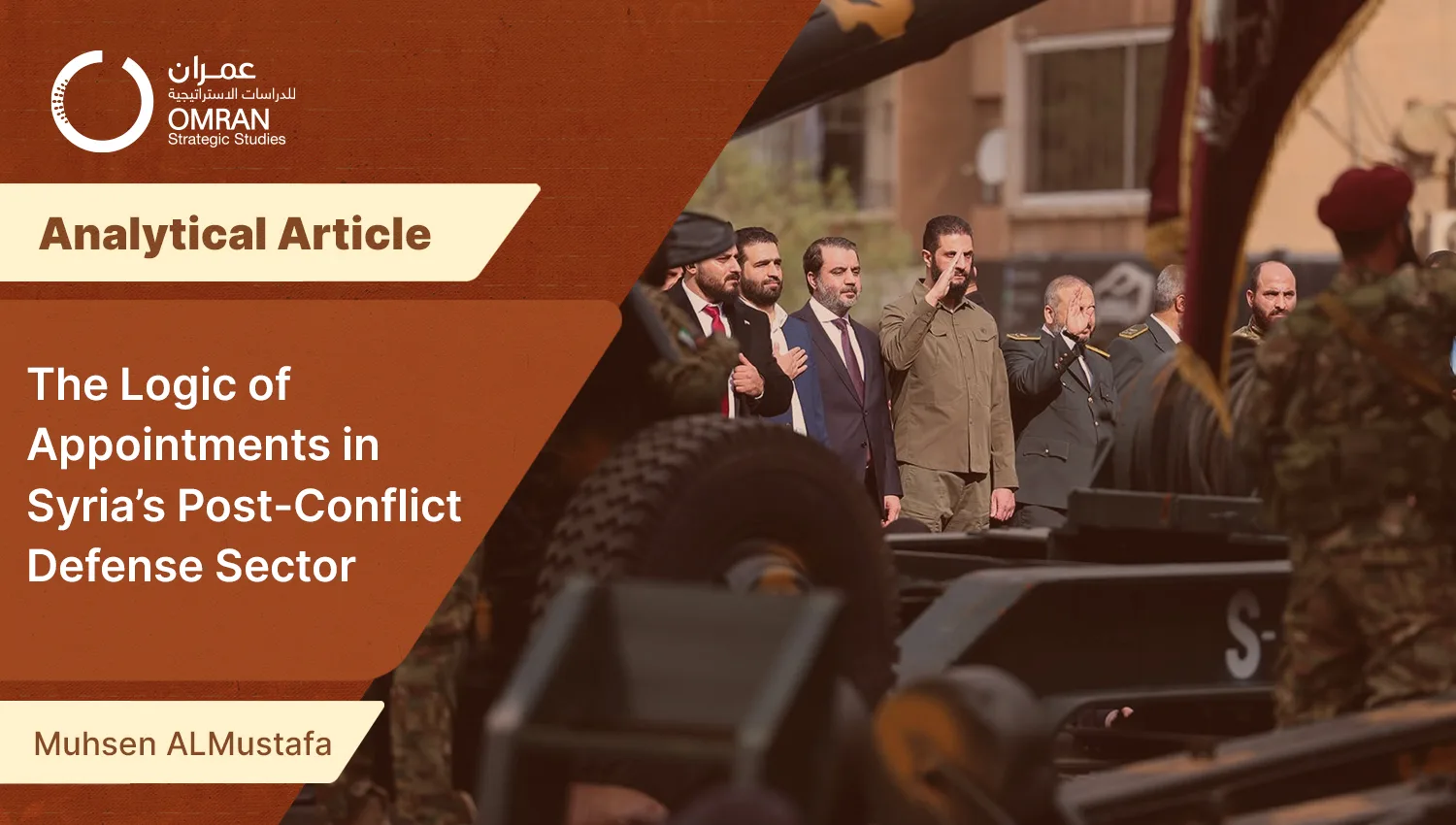
The Logic of Appointments in Syria’s Post-Conflict Defense Sector
The logic of military and security appointments in post-conflict Syria reflects an effort to transition from the logic of networks and factions to that of the state and its institutions. Yet this transition remains governed by a delicate balance between the imperatives of rapid control and organizational trust on the one hand, and the requirements of competence, representation, and legal discipline on the other.
Introduction
Syria’s post-conflict phase redefines the logic of military and security appointments, treating them not as a merely administrative process for filling vacancies or distributing positions, but as a foundational instrument for building a professional national force. This logic requires structuring centers of decision-making and operational control in a way that reinforces the state’s monopoly over legitimate authority and prevents the return or entrenchment of factionalism within institutional structures.
This approach rests on a careful balance between professional competence, legal and disciplinary compliance, and regulated geographic and social representation. Such a balance can transform appointments from a tool of temporary quota-sharing into a lever for sustainable institutional development. The current reality requires managing shortages in certain specialized human resources, uneven levels of experience, and the accumulated legacy of factionalism. As a result, the pace of implementation depends less on the pursuit of ideal solutions than on the administration’s ability to manage risks effectively.
This article offers an analytical reading of the logic governing military and security appointments within Syria’s post-conflict defense sector. It treats appointments as a reflection of power balances and the emerging shape of the state, rather than as mere administrative procedures. In the transitional phase, appointments are not simply about filling posts; they are a tool for regulating absorption and integration, and for redistributing armed elements within the structure of the state. The article also seeks to unpack the active structures within the defense sector by analyzing maps of influence and organization, and by identifying the challenges that shape the appointment process. This allows for a deeper understanding of the formation of the new authority and its instruments.
At the same time, the article does not assume that the current distribution of positions represents the final form of the military and security institutions. Rather, it treats this distribution as a transitional expression of a post-conflict founding moment, in which considerations of trust, readiness, and rapid control take precedence over the requirements of full institutional balance. Accordingly, describing network concentration or disparities in representation is not intended to negate the declared path toward a unified national army, but to explain the actual conditions from which this path begins and to measure the distance between the current transitional structure and the intended institutional model.
In this context, the logic of appointments is not intended to justify the filling of posts or merely describe current distributions. Rather, it refers to the governing framework that defines the purpose, criteria, and limits of appointments within the new state. Accordingly, appointments in the defense sector should be understood through four interconnected pillars: loyalty to the state and the institution rather than to previous networks; competence and specialization; legal and disciplinary compliance; and regulated representation without quota-sharing or rigid particularisms. The value of an appointment is therefore measured not only by who occupies the position, but by the extent to which it contributes to building a sustainable, professional national institution.
A Realistic Assessment of Defense Sector Appointments
The database on the distribution of leadership positions within the military and security institutions reveals a map of influence concentrated around three main networks([1]): Hay’at Tahrir al-Sham (HTS), the Syrian National Army (SNA), and ideological or local formations such as Ahrar al-Sham and others, alongside the presence of non-Syrian personnel in positions that may be considered sensitive or specialized. This influence is not limited to combat units. It also extends to decision-making and support centers at the top of the institutional hierarchy, helping explain the rapid formation of effective chains of command alongside the slower unification of professional standards.
Leaders associated with HTS and the Battle of Deterrence of Aggression appear to constitute the bloc with the greatest influence over the upper levels of decision-making. Appointments linked to the Ministry of Defense, the General Staff, the Air Force, the General Authority for Supply and Provision, and the intelligence apparatus all intersect with an HTS background and are geographically distributed across Hama, Idlib, Rural Damascus, and Deir ez-Zor. In practical terms, this means that one network appears to hold significant influence over four of the most sensitive axes: general command, resource management, intelligence, and the Ministry of Interior ([2]).
When these nodes come together in the hands of a cohesive organizational structure, prospects for internal balance within the institution naturally decline, while that network’s ability to shape appointment policy in line with its interests expands. These interests may be interpreted as Syrian national interests, even if they produce localized friction with other networks. This distribution can be understood as a product of the requirements of the transitional phase, as well as the mutual trust among the figures currently in charge. It is also a natural outcome of the military victory led by HTS in the Battle of Deterrence of Aggression, which ultimately led to the fall of the Assad regime, followed by the Victory Conference and the decisions that emerged from it ([3]).
By contrast, the Syrian National Army appears as a widely distributed formation across medium- and high-ranking ground units, extending from Hama to Rural Damascus, Deir ez-Zor, Aleppo, Homs, and the coast. A clear Turkmen presence is also visible in the north, through the appointment of Fahim Issa as Deputy Minister of Defense and Saif al-Din Bolad as commander of the 76th Division, alongside defected commanders and officers who had worked for years within the Syrian National Army and were later appointed to leadership positions. These appointments contribute to strengthening institutional sovereignty over formations that had previously belonged to the Syrian National Army, while unifying the chain of command in line with field requirements and state policy.
Ahrar al-Sham, for its part, maintains a selective yet influential presence in specific units, such as the 40th Division in Daraa and the 54th Division in Hama, giving an ideological imprint to geographically distant areas. The appointment of a commander in the 82nd Division with an Ansar al-Tawhid background adds another layer of ideological diversity within the ground formations. These backgrounds coexist within a single system without a final resolution of the issue of ideological integration, which helps explain the need for transitional or phased placements in some executive positions. There is also a noticeable tendency among Ahrar al-Sham leaders to move out of the military track and into other pathways. This includes the movement’s leader, Amer al-Sheikh, who became governor of Rural Damascus([4]), and his deputy, Ahmad al-Dalati, who moved through several civilian and security positions, from governor of Quneitra to commander of internal security in Suwayda and, most recently, in Rural Damascus ([5]).
In this context, it is worth noting that the process of military appointments was accompanied by a systematic redeployment and repositioning of combat units. Some commanders were transferred, while some of their previous formations were dismantled and integrated into other formations located near the areas from which their members originate. This organizational choice, which in some cases was carried out through voluntary preference, reflects an effort to achieve a degree of social and operational cohesion within the formations and to reduce the likelihood of internal tensions. The military victory achieved in the Battle of Deterrence of Aggression also provided a wide margin for rearranging the command structure on foundations more closely connected to local environments. This helps explain the appointment of many commanders in areas to which they originally belong, a pattern that may be viewed positively in terms of strengthening affiliation and discipline.
However, this geographic and social dimension in appointments or redeployment should not be understood as an acknowledgment of regional, religious, or ethnic particularisms within the institution. Rather, it should be seen as a transitional tool for improving cohesion and effectiveness within a single national chain of command. There is a clear difference between regulated representation within a unified institution and the entrenchment of rigid blocs or permanent privileges based on identity or geography.
Challenges of Integration and Institutional Discipline at Leadership Levels
The divergence is not limited to organizational background. The data also reveal the integration of non-Syrians into sensitive state and security positions, such as the Republican Guard, led by Brigadier General Abdulrahman al-Khatib, and the 70th Division, known as the Damascus Division, led by Brigadier General Omar Jiftji; both are affiliated with Hay’at Tahrir al-Sham([6]). This indicates that the appointment process has absorbed non-Syrian cadres” for operational reasons and alliance-network considerations. Yet it has not, so far, established a transparent legal framework regulating their official status, the limits of their authority, and mechanisms of national accountability in the event that ideological commitments conflict with the requirements of sovereignty, although no such conflict has appeared to date. The significance of this issue increases when non-Syrian backgrounds intersect with organizational affiliations that hold strong internal influence.
At the same time, a series of diverse appointments has been recorded in several military positions involving figures with no declared factional background, as well as officers who originally defected from the Assad regime. This represents a notable exception that can be built upon to create a professional axis within the military institution. Both the Ministry of Defense and the Ministry of Interior have worked to absorb defected officers according to priorities based on field experience and operational readiness, while providing broader opportunities for defectors who had been active within armed factions, followed by defectors abroad. The most recent example was the announcement of the formation of the Ministry of Defense’s advisory body, composed of a select group of defected officers([7]).
Programs have also been initiated to qualify commanders with civilian backgrounds by enrolling them in military colleges in order to reclassify them as regular officers, as part of a plan previously announced by the Minister of Defense([8]). The importance of defected officers here stems from the fact that they do not merely fill gaps in certain specializations. They also play a transitional role in transferring regular military experience and professional discipline into the new structure. Their place in appointment policy therefore becomes a test of the seriousness of the shift from network-based power to institutionalization.
Nevertheless, the weight of some appointments of defected officers may be diminished by the concentration of influence held by a specific network over supply channels and operational decision-making. This means that the impact of these appointments will remain limited unless decision-making and support functions are distributed among officers from diverse military backgrounds. Overall, the success of this path remains contingent on transparency and on consolidating the principle that the military institution is subject to civilian authority.
Thus, the real challenge does not lie in the existence of trust networks that led the moment of victory and foundation as such. Rather, it lies in the state’s ability to prevent these networks from turning from a transitional bridge into a permanent basis for producing decisions and appointments. The success of restructuring will be measured by the extent of the gradual shift from the legitimacy of trust and military victory to the legitimacy of procedure and institution; that is, from the concentration of decision-making within cohesive networks to a broader system of distribution, clearer standards, and stronger subordination to civilian and legal accountability.
Security Coordination and a New Structure
On another level, appointments within the Ministry of Interior reveal the extension of Hay’at Tahrir al-Sham’s influence into the police and administrative leadership structure, from Rural Damascus to Aleppo, Idlib, Deir ez-Zor, Homs, and other areas. This extension enables rapid security coordination between the police and military security bodies. At the same time, however, it narrows the space for the institutional plurality and diversity needed for effective oversight, while making the internal control system more vulnerable to any disruption at the center of the network.
With regard to the National Security Council,([9]) President Ahmad al-Sharaa issued Decision No. 5 of 2025 on March 12, 2025, establishing the Council one day before the issuance of the Constitutional Declaration([10]). This timing is significant given the Council’s connection to Article 41 of the Declaration, which provides for its role in declaring states of emergency, mobilization, war, and other related matters.
The decision establishing the Council designated the President of the Republic as its chair and included as members the Minister of Foreign Affairs, the Minister of Defense, the Director of General Intelligence, and the Minister of Interior. It also provided for two advisory seats appointed by the president, as well as one specialized technical seat also appointed by him. Excluding these last three seats, whose holders remain unclear, all of the Council’s known leadership figures are drawn from commanders of the Battle of Deterrence of Aggression and from Hay’at Tahrir al-Sham, including the President of the Republic([11]). This does not necessarily mean that the three remaining seats will be assigned to figures from outside HTS, especially given the absence of information about their identities.
Considerations of Representation and National Identity
Overall, the data point to a leadership map heavily weighted toward Arab Sunni affiliation, with a visible Turkmen presence and an almost complete absence of non-Sunni or non-Arab currents at the top of the hierarchy, with the exception of the appointment of Samir Aso, also known as Sipan Hemo, as Deputy Minister of Defense for the eastern region([12]). This degree of homogeneity may reduce horizontal friction in the short term, but it also opens a representation gap in the medium term if not managed with political and legal sensitivity. The broader conclusion is that appointment policy in the current phase has favored the effectiveness of trusted networks in securing rapid control and building chains of command, at the expense of a more balanced distribution across backgrounds.
This is less a normative judgment than a description of the constraints of the current reality, in which immediate readiness and reliability have been prioritized amid fragile institutional structures. At the same time, there remains a need to strengthen neutral professional spaces in military education, the judiciary, and disciplinary institutions in order to absorb the effects of network concentration. This reality could improve over time, depending on the implementation of the agreement signed with the Syrian Democratic Forces, the resolution of the unresolved security and political situation in Suwayda, and the expansion of the appointment framework to include officers from more diverse ethnic and sectarian backgrounds.
Conclusion
Good governance in the security and defense sectors requires reducing the influence of informal organizational networks, expanding the role of professional actors, and establishing independent mechanisms for oversight and accountability. Transitional experiences in countries such as Colombia and South Africa show that restructuring security institutions on coherent representative and legal foundations can strengthen institutional stability and help restore social trust, provided that such transformations are managed gradually and with sensitivity to deeply rooted identities and divisions.
In the new Syria, the logic of appointments must move from contingent loyalty toward an institutional contract of trust grounded in competence and specialization. This logic can only be complete when the position itself is redefined as a public function within the state: not an extension of a network, not a reward for prior combat experience, and not a tool for satisfying temporary balances. Only then can appointments become an instrument for institution-building by distributing responsibility on the basis of competence, regulating legitimacy through law, and allowing for regulated representation in a manner that helps dismantle factionalism and transform force from organizational possession into a sovereign public function.
This path should not be assumed to be smooth or quick. It will require years of rehabilitation, incentive management, the neutralization of interest networks, and the consolidation of oversight frameworks. It will also face difficult tests in the most complex governorates. Yet this approach represents a first step toward redefining the relationship between force and legitimacy within state institutions. By turning appointments into a realistic and gradual policy managed through risk assessment rather than aspiration alone, the state can restore its monopoly over force and decision-making on sustainable national foundations, while redefining sensitive positions as functions of public service rather than political rewards.
([1]) Database prepared by the author and kept at the Omran Center for Strategic Studies. It was built through the monitoring of open-source data.
([2]) Major General Murhaf Abu Qasra, Major General Ali Nour al-Din al-Naasan, Hussein al-Salama, and Anas Khattab were all formerly members of HTS before its dissolution.
([3]) “The Victory Conference: Declaration of the Revolution’s Victory, the Dissolution of the Constitution, the Baath Party, and the Army, and al-Sharaa as President of the Republic,” Sham Network, published on: 29/01/2025, link: https://bit.ly/3HQfvJU
([4]) Hiba Muhammad, “These Are the Most Prominent Figures Who Took Charge of the Scene in Syria after the Fall of the Assad Regime,” Al-Quds Al-Arabi, published on: 17/12/2024, link: https://bit.ly/3VsxqJM
([5]) “Interior Ministry Appoints al-Tahan as Commander of Internal Security in Suwayda and al-Dalati in Rural Damascus,” SANA, published on: 02/09/2024, link: https://bit.ly/4mPFjVK
([6]) Abdullah Suleiman Ali, “Republican Guard Led by a Jordanian and Six Divisions: The Syrian Defense Ministry Completes Building Its Organizational Structure,” An-Nahar, published on: 10/02/2025, link: https://bit.ly/4cLmWyx
([7]) “The Advisory Body of the Ministry of Defense Discusses Its Working Mechanism and Tasks in Its First Meeting,” SANA, published on: 29/03/2026, link: https://bit.ly/41zxqLi
([8]) “Interview with Syrian Minister of Defense Murhaf Abu Qasra,” Syrian Al-Ikhbariya, published on: 26/05/2025, link: https://bit.ly/4p9oZju
([9]) “Presidential Decision No. 5 of 2025: Establishing the National Security Council,” Syrian Memory Institution, published on: 12/03/2025, link: https://bit.ly/4n23kIP
([10]) “The Constitutional Declaration of the Syrian Arab Republic,” Sham News Network, published on: 13/03/2025, link: https://bit.ly/46bmyGj
([11]) Muhsen ALMustafa, “Civil–Military Relations in Syria Face a Difficult Path Toward Institutional Balance”, Misdad: The Syrian Center for Security and Defense Studies, 08/09/2025, https://bit.ly/4mUQ3Cf
([12]) “Appointment of Sipan Hemo as Deputy Minister of Defense for the Eastern Region,” Syrian Al-Ikhbariya, published on: 10/03/2026, link: https://bit.ly/4tFXC2w